Key takeaways
- Under international law, Indonesia has the obligation to ensure transit passage in the Malacca Strait; imposing a fee on vessels passing through the strait is illegal.
- However, Indonesia can maximize its strategic location by improving port infrastructure for maritime services, including bunker supply, ship-to-ship transfers, underwater hull cleaning, and crew services, which currently lag behind those of its neighbours.
Might Indonesia impose a toll fee in the Malacca Strait? The question has become headlines since last week, when Indonesian Finance Minister Purbaya, half-jokingly, mentioned it at a symposium. Not long after, the head of the Indonesian coast guard (BAKAMLA), Vice Admiral Irvansyah, spoke to the media, offering support for the idea. He argues that Indonesia should take more advantage of the strategic location of the Malacca Strait. After so much pushback from commentators and the media, Minister Purbaya then clarified that it was not a serious policy idea.
Even if these are jokes or unserious musings, the basic idea reflects a longstanding recognition among many Indonesian leaders that their archipelagic waters include some of the world’s most economically essential waterways and that those geographic realities have often brought their nation more burden than benefit. Furthermore, it is correct that Indonesia has not maximized the potential of its strategic locations to generate revenue for the country. More to the point, if we compare the revenue generated from the Malacca Strait, Indonesia is far behind its neighbours, Singapore and Malaysia.
What are the legal ways Indonesia can increase revenue from the Malacca Strait?
Under the United Nations Conventions on the Law of the Sea (UNCLOS), Indonesia, Singapore, and Malaysia, as countries bordering the Malacca and Singapore straits, have the obligations not to “hamper” or “suspend” transit passage in those international straits (Article 44). Imposing a charge fee on a passage in the Malacca Strait is therefore illegal under international law.
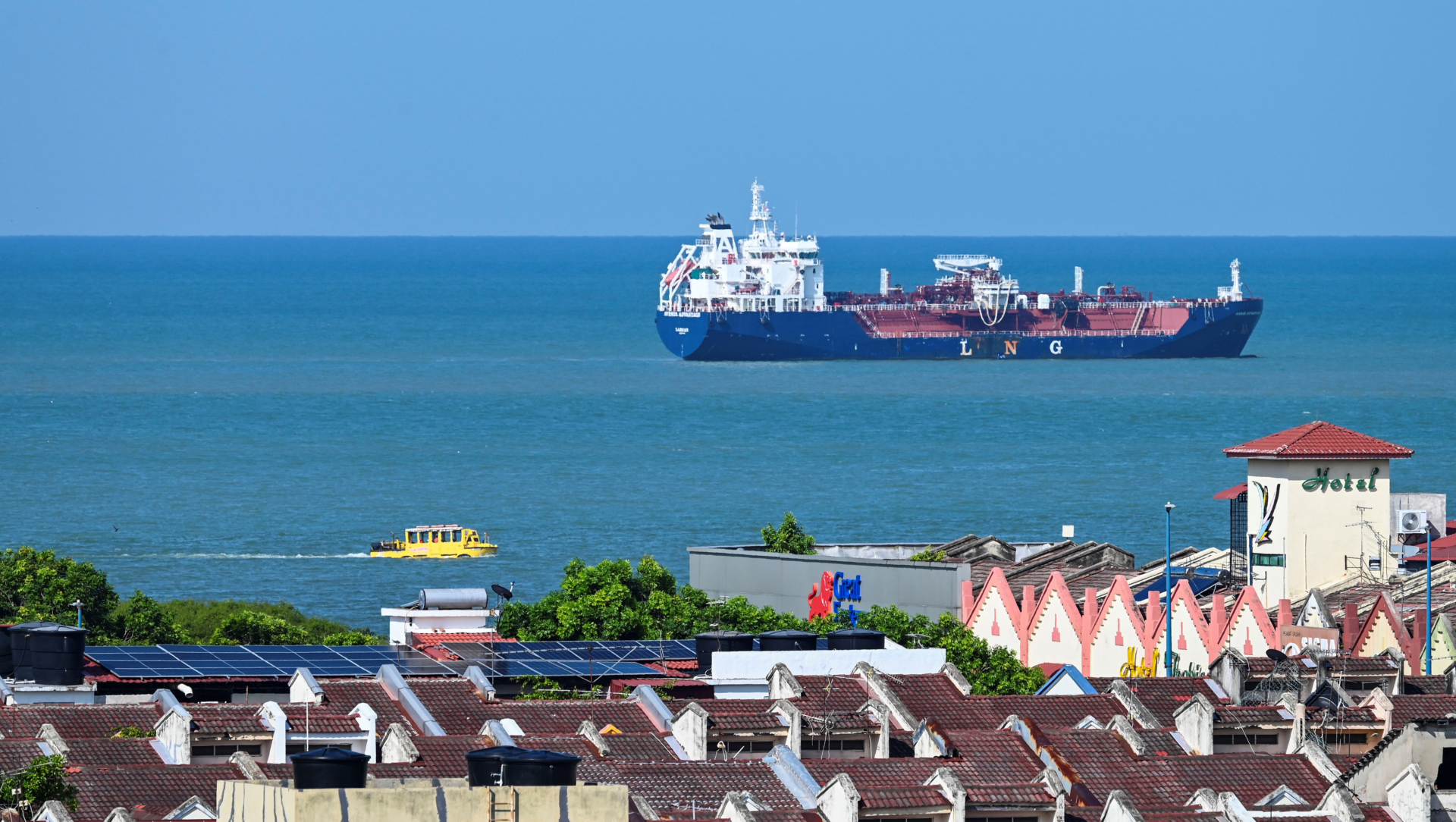
The Malacca Strait is one of the busiest chokepoints in the world. The With such huge number of vessels passing through the straits, there is an opportunity to provide services that are needed for those vessels passing through the straits.
Indonesia’s maritime service industry lags behind that of its neighbors
Indonesia is currently far behind Singapore and Malaysia in terms of maritime services for those vessels. Here, Singapore’s port dominates. Ranked as the world’s second busiest container port, Singapore’s port revenue increased by 7% in 2025 to reach $8.26 billion.
While not at the scale of Singapore, Malaysia’s ports have been expanded and modernized to similarly profit. Port Klang in Malaysia has also become an important services provider to vessels passing through the Malacca Strait. Though it ranks below Singapore, it is one of the world’s ten busiest container ports and a key maritime services provider for vessels passing through the Strait. Tanjung Pelapas, just next to Singapore, is not far behind: already the 15th busiest container port, it is growing rapidly in terms of throughput and profitability.
Though Indonesia spans the largest part of the Malacca Strait it earns much less than its two neighbors, with its two busiest ports on the strait falling far behind Singapore and Malaysia’s. Even added together, their sum throughput is only about one tenth of Port Klang or Tanjung Pelapas. These Indonesian ports are not only limited by their physical capacity, but are also hamstrung by their reputations for being inefficient and unreliable for business. Issues such as bribery continue to be perceived as significant problems that suppress business interests from entering. Government revenue and investors, such as DP World, are funding the expansion of both ports, but governance and management reforms will be needed to maximize the return on these investments.
Indonesia has underexplored its comparative advantages
While Indonesia might be behind the curve in terms of transhipment services, it has some comparative advantages that could create opportunities for greater profits. Its lower labor costs should enable it to be more competitive in a wide variety of other maritime services. For example, Indonesia’s revenue from the Malacca Strait currently mostly relies on pilotage and vessel towage services, which are run by the state-owned enterprise PT Pelindo. There is no reason these could not be enlarged. Ship repair services could be similarly expanded.
Crew services could be a particularly attractive area for focus. Food, hotels, and recreation opportunities are all much cheaper in Indonesia than across the Straits. While Changi and Kuala Lumpur airports provide convenient connections that enable efficient crew changes, Medan and Batam also offer regional connectivity at low cost. Given that Indonesia is the fourth leading source of seafarers (after the Philippines, China, and Indonesia), it also has socio-culture advantages that could be leveraged.
If Indonesia seriously wants to increase revenue from its strategic locations in the Malacca Strait, it cannot take the shortcut of imposing a toll on vessels passing through the Malacca Strait. Instead Indonesia should adopt serious policies and invest in building a strong infrastructure to support maritime services that can compete with its neighbors in the Malacca Strait and expand the profits it earns from the Strait’s growing traffic.
Cover photo: Cheng Yiheng/Xinhua via Getty Images

