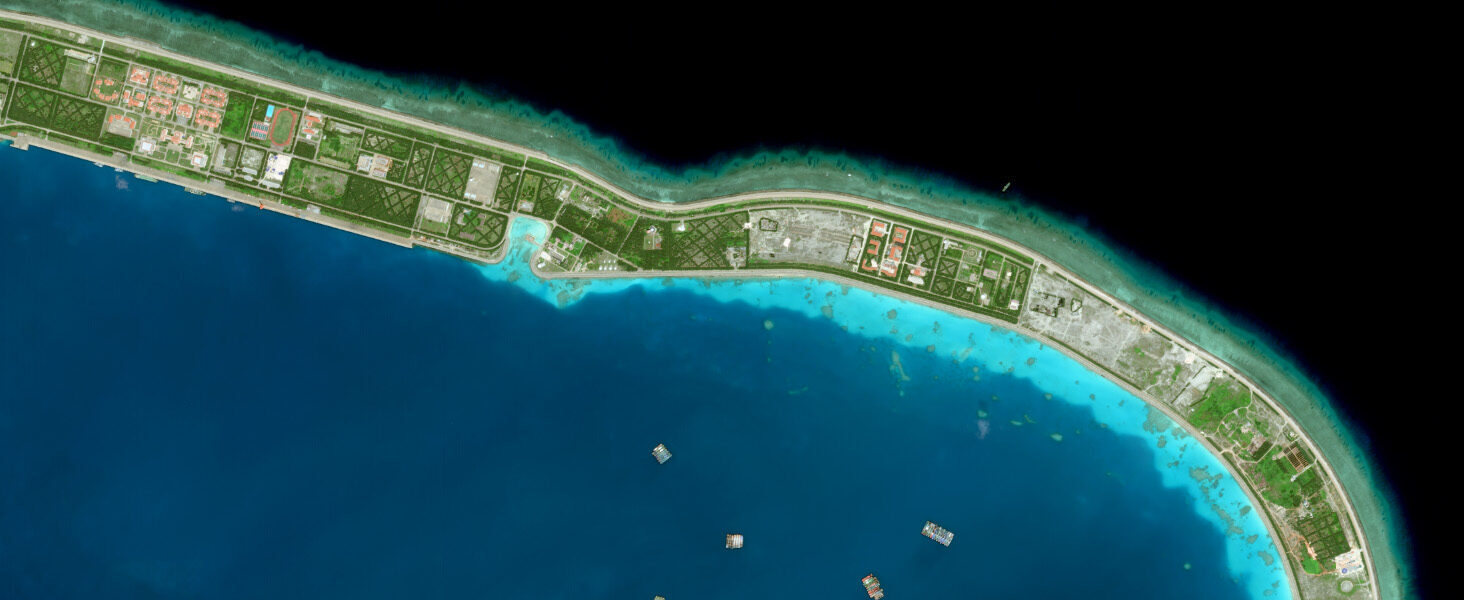
China’s artificial island bases have been out of the spotlight in recent years, with most coverage of the South China Sea instead focused on the activities of China’s coastguard, navy, and militia—or on Vietnam’s eye-catching efforts to expand its own outposts. But in the years since AMTI last looked at Chinese island upgrades in 2022, Beijing has built a number of new facilities on its Spratly Island outposts aimed at enhancing its signals intelligence, electronic warfare (EW), and defensive capabilities.


Antenna Arrays and Mobile Units at the Big Three
New facilities likely designed to support vehicle-deployed EW or intelligence, surveillance, and reconnaissance (ISR) systems have been installed on all of China’s “big-three” Spratly outposts: Fiery Cross, Mischief, and Subi reefs.


At least six paved areas arrayed with fixed monopole antennas were installed across the three islands from 2023 through 2024. Each antenna array is oriented outward toward the sea with no other structures in front to obscure line of sight.
The facilities appear to be associated with units of three vehicles carrying sensing/communications equipment that operate in close proximity or parked directly on top of the fixed arrays. Identification of specific systems is difficult even in aerial photography, but the grouping resembles several Chinese mobile EW systems where each vehicle carries different jamming equipment for targeting specific bands of the electromagnetic spectrum. The vehicles are usually partially covered in camouflage tarps, and a fixed roof structure was built in 2025 to house the group on the northwest tip of Subi Reef. But the rear of the vehicles is often left uncovered, likely to allow for proper functioning of antennas.

The facility at Mischief reef, uniquely, features 5 vehicles deployed on linked pads to the south of the fixed antenna array, though digging visible during construction indicates a hardwired connection between the facilities. Digging during the construction of two arrays at the southwestern end of Subi Reef shows connections to an older EW deployment area and one of several point defense towers that populate China’s outposts.

Similar vehicles and antennas have been seen previously on grids of concrete pads on either end of Mischief Reef. But unlike those areas, which seem designed for flexible deployment of varying equipment, the distinct design of these newer facilities and their associated vehicles suggest a more specific function—one that Beijing wants replicated at multiple locations across all three of its largest outposts.
Potential EW deployment area on Mischief Reef
Another facility likely related to EW has appeared on the eastern end of Mischief Reef.

A concrete circle approximately 50 yards in diameter and containing seven smaller concrete platforms was installed in 2023. This is the only area of its type visible on China’s Spratly outposts, but it has similarities to older and larger circular concrete areas on Subi and Mischief designed for the deployment of mobile EW systems to specific positions. The platforms would enable the rapid deployment of antennas around a central command unit on level ground and at fixed distances, with the circular array suggesting a potential direction-finding purpose.
ISR Radomes at Subi
A pair of matching radomes were completed on opposite sides of Subi Reef in early 2025.


The radomes appear nearly identical in design to pairs that have existed on Fiery Cross and Mischief Reef since 2017, and which were identified in 2020 by J. Michael Dahm as an ISR system providing broad range, overlapping coverage in the South China Sea. Like those on Fiery Cross and Mischief, the radomes on Subi each feature a smaller antenna in front that may aid in direction finding or cueing for the larger antenna. The pair is oriented at opposite bearings, suggesting that the two are linked and that their sensing coverage is directionally based.
Coastal Emplacements at Mischief
Though the bulk of China’s upgrades are geared toward the electromagnetic spectrum, Beijing is also investing in support facilities for equipment with more kinetic potential.


Three sets of three earth-fortified emplacements were built along the western and northern edge of Mischief Reef over the course of 2023. The emplacements are often empty but satellite imagery routinely shows them covered with tarps for weeks or months at a time. And unlike the EW vehicles which are forced to operate partially uncovered, whatever platforms have been deployed to these positions have remained hidden from view. The positions are likely capable of accommodating a wide variety of road-mobile weapons platforms, including artillery guns or rockets, or even vehicle-mounted versions of the same close-in weapons systems installed on the point defense towers on the islands.
Keeping Up with the Joneses
These upgrades underscore the fact that a major function of China’s bases is to provide unparallelled ISR coverage of the South China Sea, supporting the operations of China’s coastguard and navy in peacetime and allowing Beijing to contest the use of the electromagnetic spectrum by others in the event of a conflict. As Vietnam installs infrastructure on its own newly expanded outposts, it will be worth watching whether it also follows in China’s footsteps in this regard—though Hanoi may find it easier to match the scale of Beijing’s dredging than its ISR and EW footprint.


