After a 2025 fraught with deadly clashes on their land border, Thailand and Cambodia have turned to a seldom-used article of international law to resolve their overlapping maritime claims.
On September 15, the foreign ministers of Thailand and Cambodia delivered opening statements in Singapore before a conciliation commission constituted under the United Nations Convention on the Law of the Sea (UNCLOS). These proceedings marked the start of only the second compulsory conciliation under UNCLOS since the convention entered into force in 1994. Cambodia turned to the procedure after Thailand earlier this year terminated a bilateral memorandum of understanding (MOU 44) that provided a framework for governing the two countries’ overlapping maritime claims in the Gulf of Thailand. The commission’s first major task will be to establish the scope of the proceedings.
A ceasefire declared in December has put a pause to major armed conflict at their land border but tensions between the two countries remain high. And in a region fraught with unsolved maritime disputes, whether this process is successful will have important implications not only for Thai-Cambodian relations, but for Southeast Asia at large.
MOU 44’s Termination and Cambodia’s Response

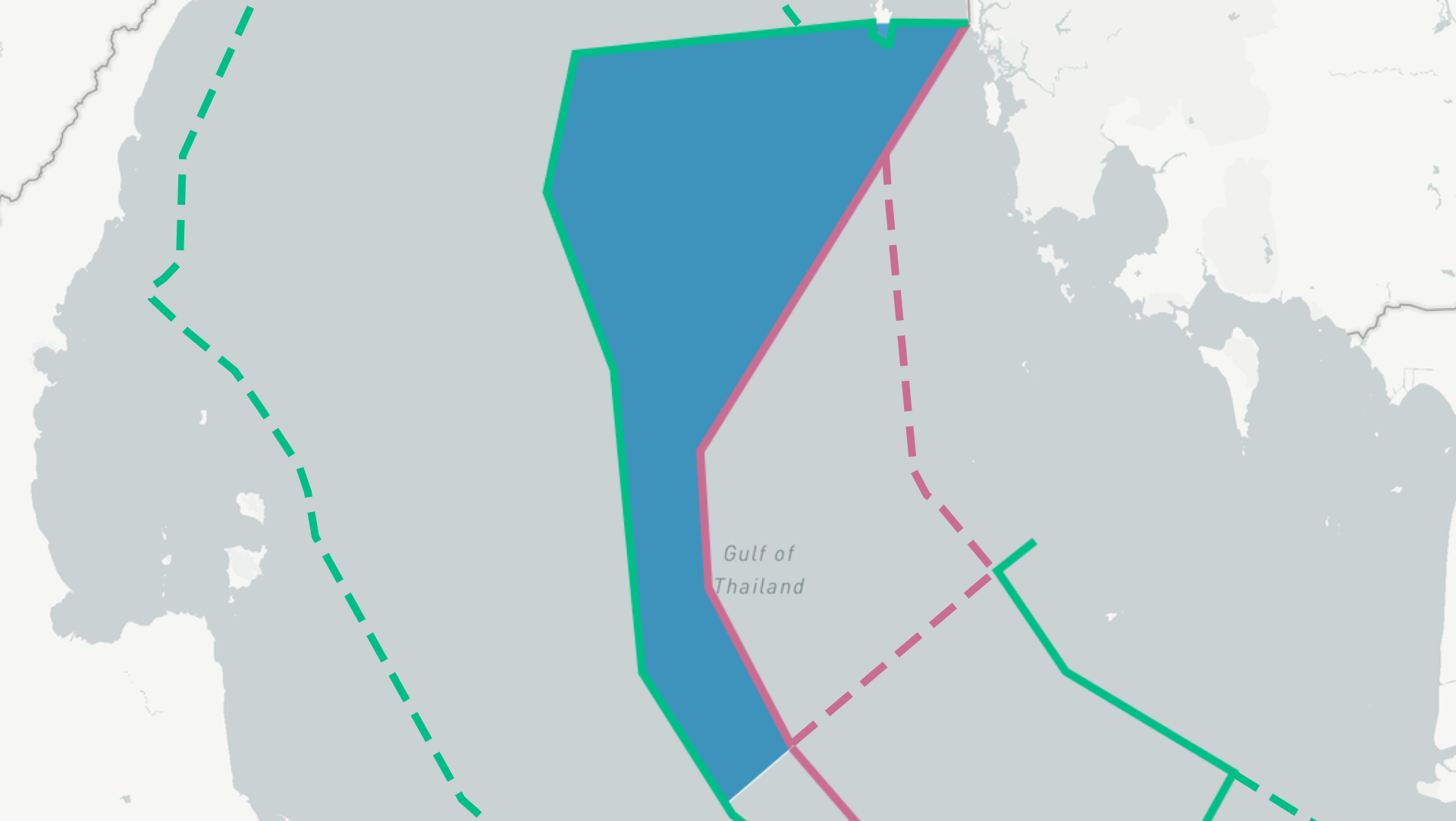
Map showing Thailand and Cambodia’s EEZ and continental shelf claims, and the Overlapping Claims Area (OCA) mapped in MOU 44
Signed in 2001, MOU 44 acted as a framework for Thailand and Cambodia to delimit overlapping maritime boundaries and jointly develop resources across an overlapping claims area (OCA) of approximately 10,000 square miles. MOU 44 treated delimitation and joint development as an “indivisible package” but the two governments only held five rounds of talks and never reached an agreement on either issue. Historically, Thailand has also awarded oil and gas concessions within the OCA to several companies including Chevron, PTTEP (Thailand’s national petroleum exploration and production company), and BG Asia, a subsidiary of Shell.

The scope of the OCA was adapted from Thailand’s 1973 continental shelf claim for its eastern border and Cambodia’s 1972 continental shelf claim for its northern and western borders. The origin of the area’s southern border was not specified in MOU 44 but appears derived from a theoretical line of equidistance between Vietnam’s Tho Chu Islands and Cambodia’s Poulo Wai, though the use of this line has also historically been an issue of dispute. Koh Kood/Koh Kut, an island claimed by both Bangkok and Phnom Penh but internationally recognized as part of Thailand, sits within the area. Thai officials have repeatedly said MOU 44 did not affect the country’s sovereignty over the island.
Thailand and Cambodia have never agreed to any restrictions on the operation of vessels within the OCA. Commercial automatic identification system (AIS) data from Starboard Maritime Intelligence shows that a monthly average of 57 Thai fishing vessels were observed to be operating within the OCA between September 2025 and September 2026. No Cambodian fishing vessels were observed on Starboard during this timeframe, but that is almost certainly because most Cambodian fishers are not equipped with AIS. Cambodia is one of the few nations globally to have received an illegal, unreported, and unregulated (IUU) fishing red card from the European Union due to of its inability to monitor its fishing fleet or deter IUU activities. A review of earth observation, night light, and space aperture radar vessel detections from Global Fishing Watch shows mild levels of activity without corresponding AIS in the OCA, though most detections are clustered along navigation routes.
Scrapping MOU 44 had become a prominent issue in Thailand amid deteriorating relations between the two countries last year, with Thai prime minister Anutin Charnvirakul making it a signature commitment during his campaign for the February 2026 general elections. On May 5, he officially terminated the agreement, arguing that it had produced no meaningful progress over the last 25 years and, given that Cambodia had finally ratified UNCLOS at the start of the year, the two countries could conduct negotiations under that framework instead.
Thai officials clarified that the decision was intended to reset the negotiating framework rather than end bilateral negotiations altogether. Cambodia expressed regret over Thailand’s decision and said it would pursue compulsory conciliation under UNCLOS. Cambodia officially filed its Notification Instituting Conciliation on June 2 while Thailand submitted its response and accepted the proceedings on June 19.
How Compulsory Conciliation Works
Both Thailand and Cambodia have made declarations under Article 298 of UNCLOS exempting themselves from binding arbitration procedures for certain categories of disputes. Thailand declared in 2011 that it does not accept such procedures for maritime delimitation. Cambodia initially made a similar declaration when it ratified UNCLOS this February but withdrew that portion of its declaration on May 26, just weeks after Thailand terminated MOU 44. This means that Cambodia’s latest position no longer excludes the binding procedures of Part XV for maritime delimitation, though Thailand remains opposed.
Under Article 298, a state like Thailand that has excluded maritime delimitation disputes from binding procedures must still accept the compulsory but non-binding conciliation procedure under Annex V, Section 2. Each party appoints two conciliators, who select a fifth as chair. Cambodia named Ambassador Peter Taksøe-Jensen of Denmark and Jean-Marc Thouvenin of France; Thailand named judges Rüdiger Wolfrum of Germany and Albert Hoffmann of South Africa, both former ITLOS presidents. Wolfrum also served as one of the judges on the landmark 2016 South China Sea arbitration. The four selected Australian diplomat Katrina Cooper as chair on August 14, with the Permanent Court of Arbitration serving as registry. The commission sets its own procedure by majority vote absent agreement otherwise, and its proceedings are confidential by default.
The commission must report within 12 months of its constitution. Under Annex V, the commission’s report records any agreement reached and, failing agreement, conclusions on all questions relevant to the dispute, together with recommendations it considers appropriate for an amicable settlement. Under Article 298(1)(a)(ii), the parties are required to negotiate an agreement based on the report. If those negotiations fail, they can proceed to binding dispute settlement only by mutual consent.
The Timor Sea Precedent
Compulsory conciliation under UNCLOS has only been utilized once before. Timor-Leste initiated the first compulsory conciliation against Australia in April 2016. Australia initially challenged the commission’s competence, principally on the grounds of a 2006 Treaty on Certain Maritime Arrangements in the Timor Sea, under which Canberra and Dili had agreed not to pursue maritime delimitation for 50 years. But the commission ruled unanimously that it was competent to hear the dispute.
The process was ultimately successful and in October 2016, Timor-Leste and Australia agreed on an integrated package of measures to set maritime boundaries. Timor-Leste later moved to terminate the 2006 treaty and the parties continued negotiations that ultimately produced the Maritime Boundary Treaty signed in New York on March 6, 2018, and entered into force on August 30, 2019. The treaty established permanent maritime boundaries and created a special regime for the Greater Sunrise gas field, including provisions for joint development and revenue sharing.

The Road Ahead
While the Timor-Leste-Australia case sheds light on how proceedings might go, the two cases differ in an important respect. In the Timor Sea, the conciliation process helped the parties negotiate the termination and replacement of an existing resource-sharing arrangement alongside the settlement of the maritime boundary. In Thailand and Cambodia’s case, termination of the existing bilateral framework preceded, and precipitated, compulsory conciliation.
More significantly, in their first conciliation meeting in Singapore, Thailand and Cambodia expressed different ideas about what the commission should help resolve. Thailand framed its participation primarily around maritime boundary delimitation under UNCLOS. Cambodia has asked the commission to consider a more flexible settlement, seeking to establish a single maritime boundary but also exploring an agreement for joint development and equitable sharing of resources pending final delimitation.
Compulsory conciliation is intended to foster goodwill among participants; the non-binding aspect of the procedure aims to remove any finality that could cause further friction between or discourage participation by the parties. The commission has already set six more meetings, with the next to take place between October 14 and 18 at The Hague.
With the two countries beginning the process with different priorities, the coming meetings will test how effectively compulsory conciliation can function as a framework for resolving maritime disputes. The outcome will also have implications for other disputes in the region. If successful, it would reinforce the norm of Southeast Asian adherence to international maritime law and help further legitimize UNCLOS’ compulsory mechanisms, which would in turn strengthen their negotiating positions vis-à-vis China in the South China Sea. Conversely, if the process were to break down or end in non-compliance by either party, it could deepen fissures within Southeast Asia on maritime issues.


