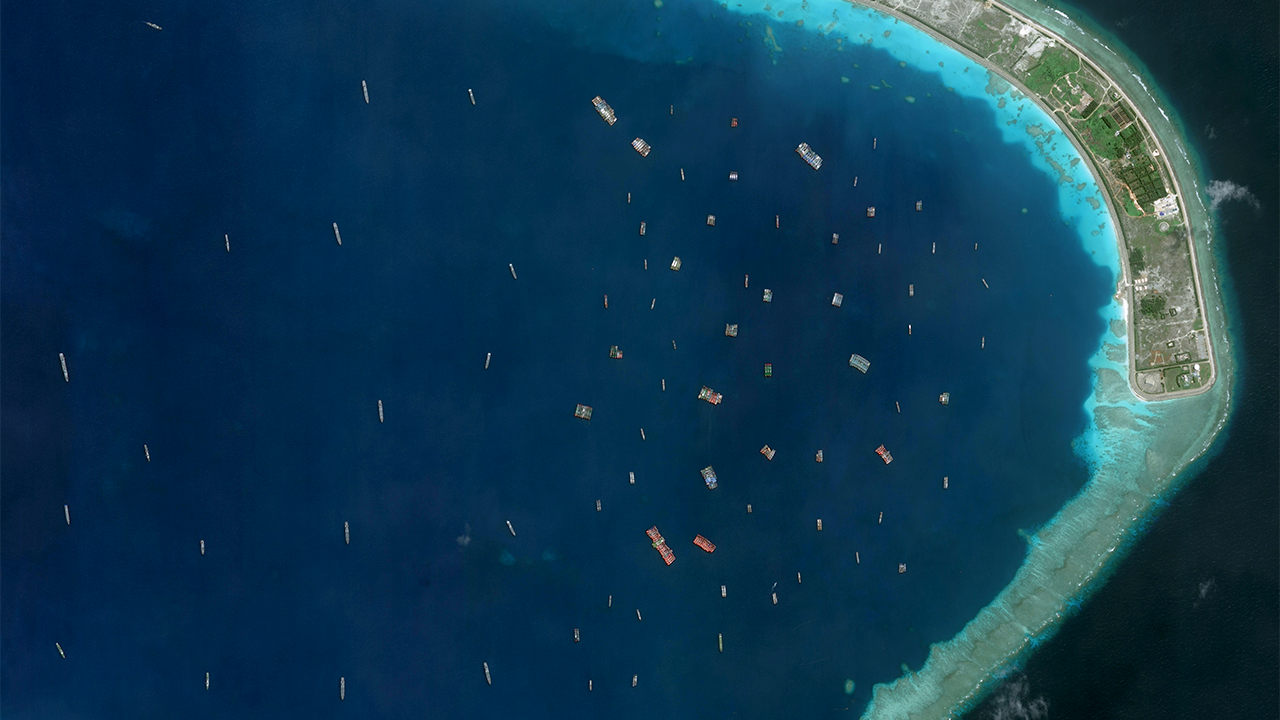
Satellite imagery analysis indicates that China’s maritime militia—consisting both of professional militia and the civilian members of the “Spratly Backbone Fishing Fleet”—deployed in record-high numbers across the South China Sea in 2025, building on the elevated activity documented in 2024. While militia deployed to all the reefs AMTI has documented since 2021, the data shows a continued shift toward concentrating most of the time at Mischief and Whitsun reefs.
While China’s maritime militia is the largest fleet of ships operating in the South China Sea, tracking their activity is difficult, as most vessels cannot be reliably detected on automatic identification system (AIS) platforms. Consistent with prior years, AMTI tracked militia activities using commercial satellite imagery of the reefs at which they congregated throughout calendar year 2025. This dataset has expanded to 12 reefs with the inclusion of Johnson Reef, where satellite imagery has shown a moderate concentration of vessels to the east of the feature over the past year.
Most of these vessels are members of the Spratly Backbone Fishing Fleet, which is numerically larger than the professional component of the militia. Although by regulation, these vessels can be as small as 35 meters in length, only ships falling between 45 and 65 meters were counted for the purposes of this study. This is the most common length for Chinese militia trawlers and a range rarely seen in other vessels active in disputed waters, such as China Coast Guard (CCG) or fishing vessels of other coastal states. Militia vessels were counted an average of four times a month at each feature, and data on days between observations was interpolated linearly between the two nearest observations to enable accurate comparison across features.
By the Numbers
AMTI counted a daily average of 241 militia vessels in 2025, up slightly from 232 in 2024. This is the highest level measured in any year, and this conclusion holds true even when excluding newly added Johnson Reef from the dataset. Seasonal patterns remained familiar: presence was lowest from January through mid-February before rising through the spring as vessels deployed following Lunar New Year. Overall, two notable surges occurred at most features in June and again in late November, echoing patterns seen in earlier years.
Given that Mischief Reef and Whitsun Reef accounted for the largest share of observed militia activity, the graphs have been adjusted from previous years to highlight that the two account for nearly half of the total count. Both features followed similar seasonal trajectories, though with moderately higher vessel counts than in 2024. At Whitsun Reef, militia presence peaked in the spring, declined through the summer and early fall, and rose again slightly in late fall, consistent with patterns observed in prior years. Mischief Reef exhibited a similar trend but with a slightly higher overall presence, including four distinct peaks exceeding 200 vessels, reinforcing its role as a hub for the militia to monitor areas of tensions with the Philippines, like Sabina Shoal and Second Thomas Shoal.

Mischief Reef, September 28, 2025
Other features experienced increases in both average and peak militia presence. Johnson Reef, newly included in the 2025 dataset, exhibited a moderate but seasonal militia presence in the summer and fall months when activity in previous years was not observed. Iroquois Reef saw a clear rise in activity, with higher peaks and a greater baseline presence throughout the year. Thitu Reef also recorded increases in both average and peak vessel counts, which contrasts with a greatly reduced CCG presence in that area over the same period. Gaven Reef reached peak levels comparable to those observed in 2024 but maintained a higher average daily presence.
In contrast, only Fiery Cross Reef experienced a sharp decline in militia activity. After averaging 32 vessels per day in 2024, the feature had almost no observable militia presence in 2025. This reduction may suggest a reallocation of Beijing’s forces rather than an overall decrease of militia presence, particularly given simultaneous increases at other features in the eastern Spratlys.
Comparing Coast Guard Activity
Militia presence remained relatively low at several features that saw significant increases in CCG activity. Similar to 2024, Scarborough Shoal hosted a relatively small number of militia vessels, a pattern that is notable given the record-high CCG presence around the feature in 2025. This likely reflects that the smaller in number, but more capable, professional militia fleet helps patrol highly contested features like Scarborough while the Spratly Backbone vessels loiter at anchor in the safety of Mischief and Whitsun. Sabina Shoal also recorded a relatively modest militia footprint, though the timing of deployments differed from 2024. Second Thomas Shoal once again showed minimal militia activity, consistent with prior patterns—more so now that Beijing’s activities have been more concentrated around and to the south of Sabina over the past year.
The militia data for 2025 echoes that for 2024, though with a slightly higher overall presence across the features. Mischief Reef remains home to the largest concentration of China’s maritime militia, in contrast to Fiery Cross which no longer hosts many at all. This redistribution of militia activity was much less pronounced than the shift in CCG patrols last year. This likely reflects the diminishing value of the Spratly Backbone fleet to China now that the international community knows they are not legitimate fishers, as well as the overriding focus on sustaining persistent CCG and professional militia operations around Scarborough and Sabina.


